The Oscillator Devices SPLIT is a 4-way active stereo splitter, designed to split a stereo or mono signal to several outputs. The SPLIT has three buffered outputs as well as a Bypass output, where the buffers are bypassed and the unbuffered signal is available.
The SPLIT has headroom dependent upon the supply voltage. It’s rail to rail, what means that the supported signal level is the same as the supply voltage. The SPLIT can handle up 18V input voltage, but 9V is sufficient for most applications.
Features:
- Three buffered stereo outputs
- One unbuffered stereo bypass
- High quality, low noise input buffers
- Handles instrument and line level signals
- Switchable to mono for up to seven mono outputs
- High-quality Amphenol connectors
- Developed and built by Oscillator Devices in Germany
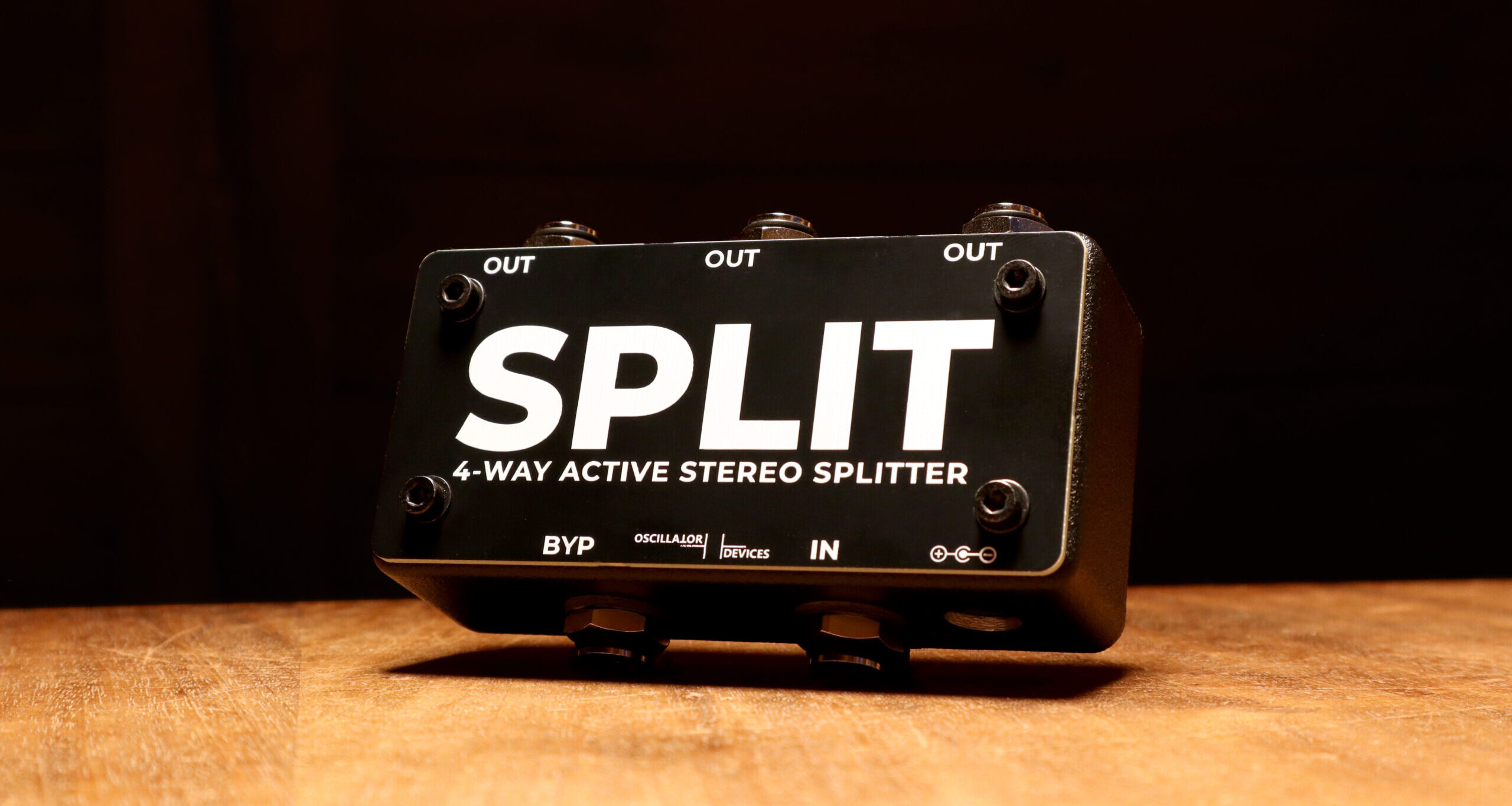
Overview
The input is split to the three outputs with a high quality low noise buffer. The input impedance of 1MΩ is perfect as an instrument input and is perfectly fine for line level signals. Even with a 9V power supply the SPLIT can handle line level signals.
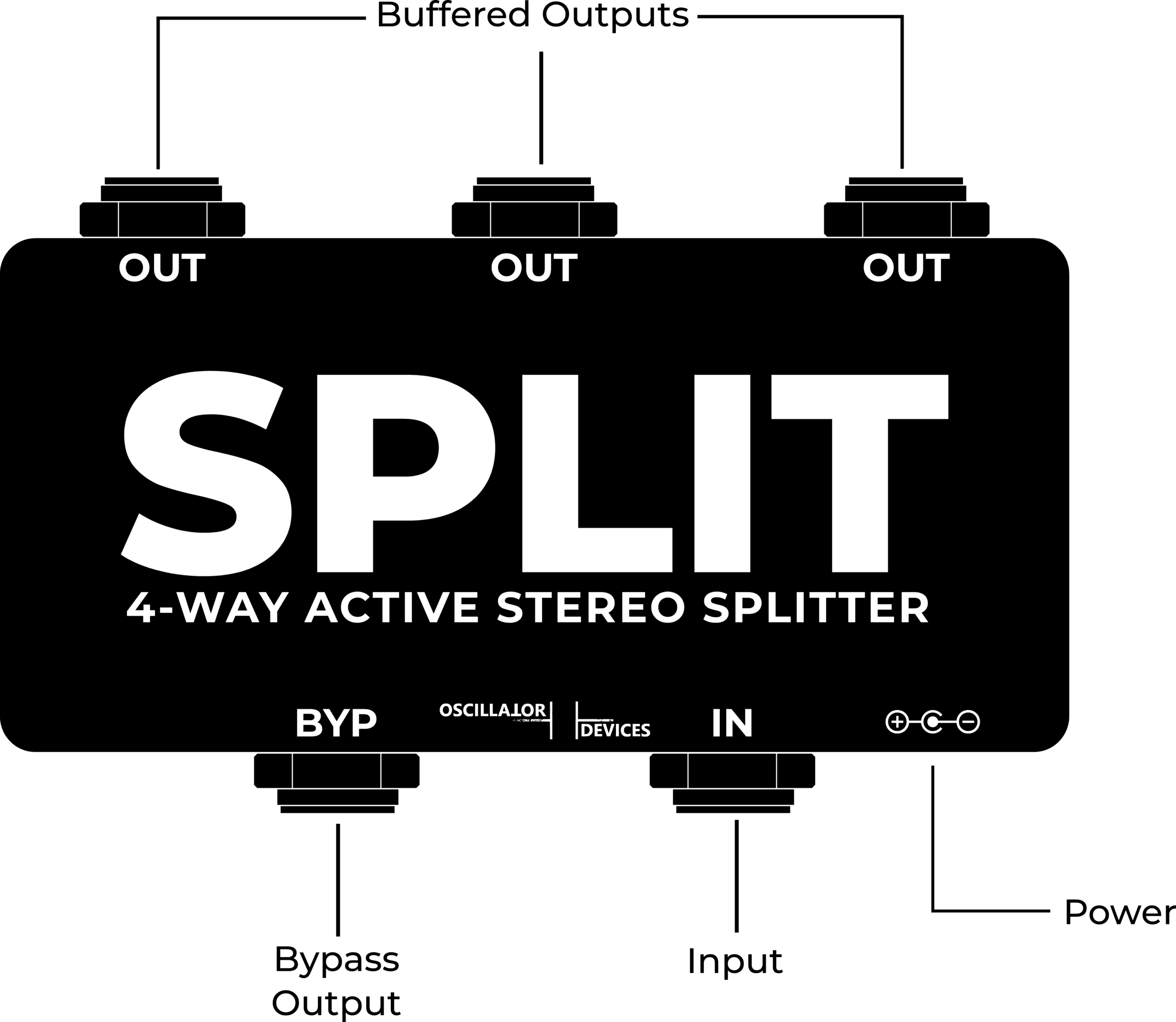
Details
Find a detailed signal flow diagram below.
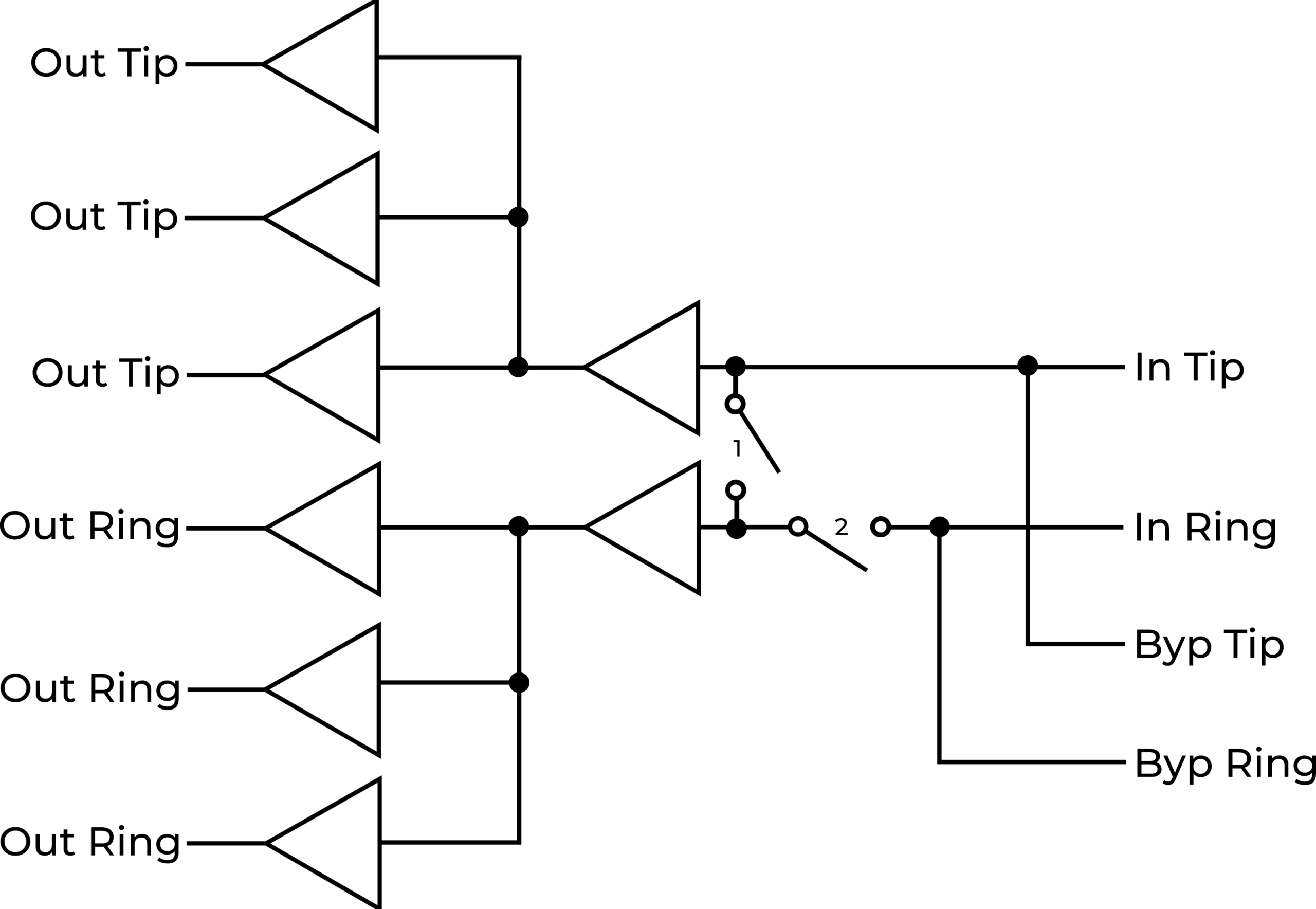
The switches labeled 1 and 2 are located inside the unit. They can be used to select between stereo operation (default) and mono operation (1 = ON, 2 = OFF).
In mono mode, the signal present on the input Tip is routed to all Tip and Ring outputs, except for the Ring of the bypass output. This exception is necessary because the Ring contact of the bypass output would be shorted to ground when using a TS plug.
Why do I need an active splitter?
A passive splitter simply connects one signal source to multiple destinations. While this works in some cases, it can cause signal loss, increased noise, reduced high-frequency response, and unwanted interaction between connected devices.
An active audio splitter uses buffered outputs to isolate all connected devices from each other. This ensures that the source always sees the correct load and that each output receives a strong, low-impedance signal. As a result, signal quality is maintained regardless of cable length or the number of connected devices.
Documentation
| Document | Version | Download |
|---|---|---|
| User Manual | SPLIT 1.0 (June 2026) |